

Hornet Flight, execute SEAD against enemy S-300 radar array at Grid 45-50. Maintain EMCON until fence-in; AWACS will provide passive vectors. Clear the skies before the armoured column advances.
That’s not a line from a movie. It’s a command I typed into my own game last week, watched an AI make sense of it, and actually move and update the pieces on the board. Finally, it worked!
A mountain of side project ideas
Having a lot of ideas every day, working with studios and founders who have a lot of ideas has one big drawback: they just keep piling up, and don’t get enough attention, all competing for the same evenings and weekends.
About four months ago I decided to do something against this, and started to sift through countless post it notes, email drafts, Notion entries. Applied a bit of common sense and venture studio mindset:
bunched them together into 12 main themes
discarded 3 of those on the basis of no real interest, no emotional buy-in
another 2 eliminated because I felt those would not provide any new learning
basic sanity check eliminated 4 more (simply too big for me right now)
ran research for the remaining 3 (market, trends, potential…)
let my gut feeling pick the winner…
I call it Kill Chain: Command by Intent. If I wanted to make a poster that conveys the vibe, that would look something like this:
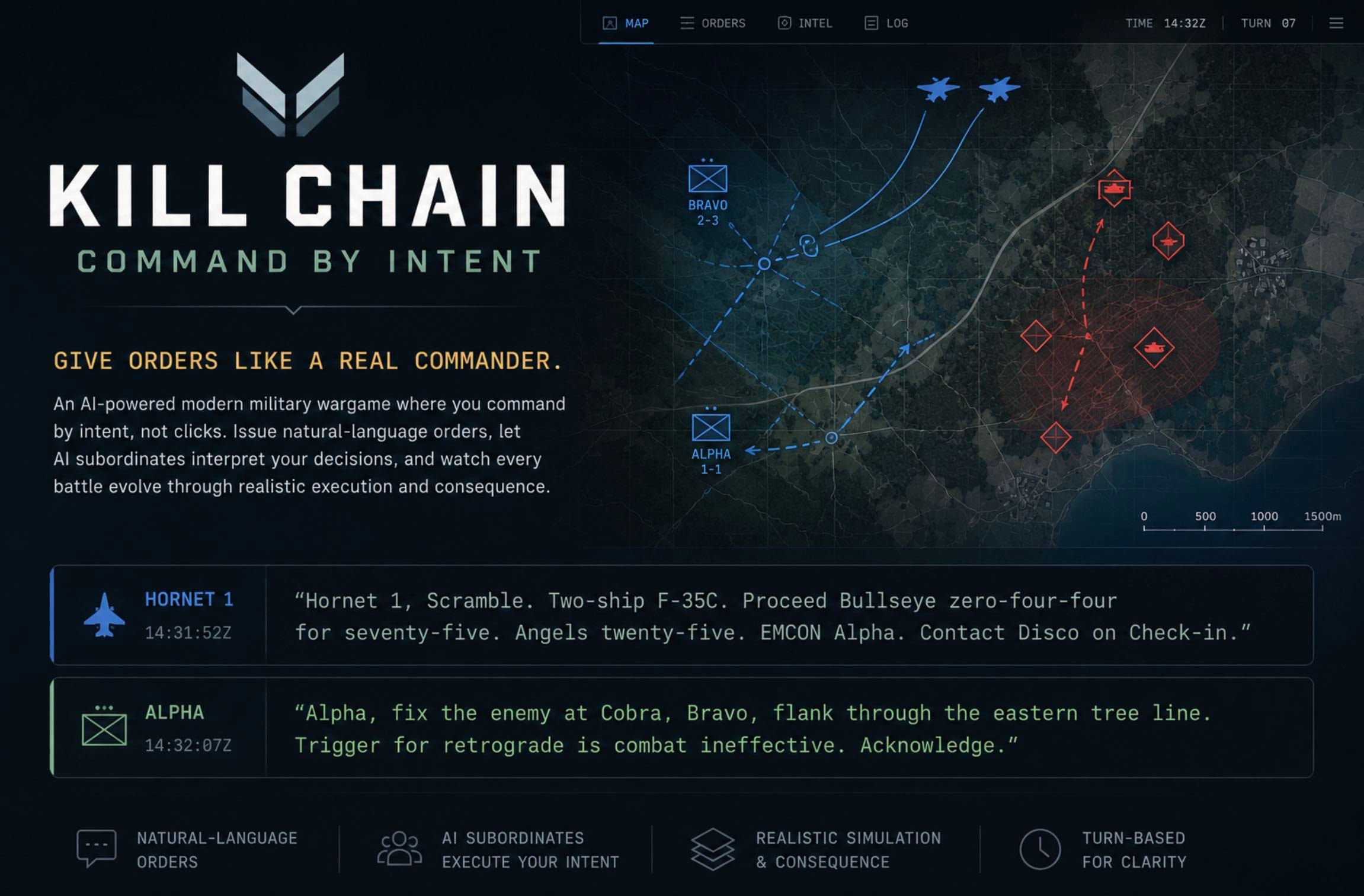
Why a wargame, of all things
I played a lot of strategy games as a teenager: HoMM, Panzer General, X-COM: UFO Defense - if you know, you know. These days I don’t play many games at all. Maybe one every five to ten years actually holds my attention long enough to matter.
This year it was time again to choose a game, and I had a very specific game in mind:
A modern tactical wargame that lets players resolve scenarios like a tactical commander sitting in the command & control node.
I also wanted it to be a turn-based game where turns are executed simultaneously.
Oh and I absolutely wanted the game to take free-form text commands instead of clicks!
Quite a wish list!
And since I didn’t find a game that exactly matched, I decided to build it. The first proof of concept was just a big structured prompt tasking the LLM to act as game master, had a few defined units, a scenario, game rulebook. It was quirky, fragile, but good enough to demonstrate the core player experience I wanted.
“Bravo Company, secure the bridge and establish a defensive perimeter.” “Alpha, fix the enemy at grip 10:13, flank through the eastern tree line.”
An LLM interprets the intent, plans the details, coordinates the units, and simulates the outcome. Of course, llm-s drift and hallucinate. So to ensure coherence and integrity even through long 15-20+ turn games, I had to build a backend that enforces the rules, the “game physics”, so all that stay deterministic.
The AI is the intent director, the backend keeps everything coherent.
And the best part: as a player I can finally move from clicking hundreds of time per turn to actually tell my units what I want them to do.
The first 3-4 PoC/prototype versions were all short lived, I used them as short, low-effort, discardable experiments that each provided one key learning. And I just kept chaining together those learnings until the game as a whole started to work.
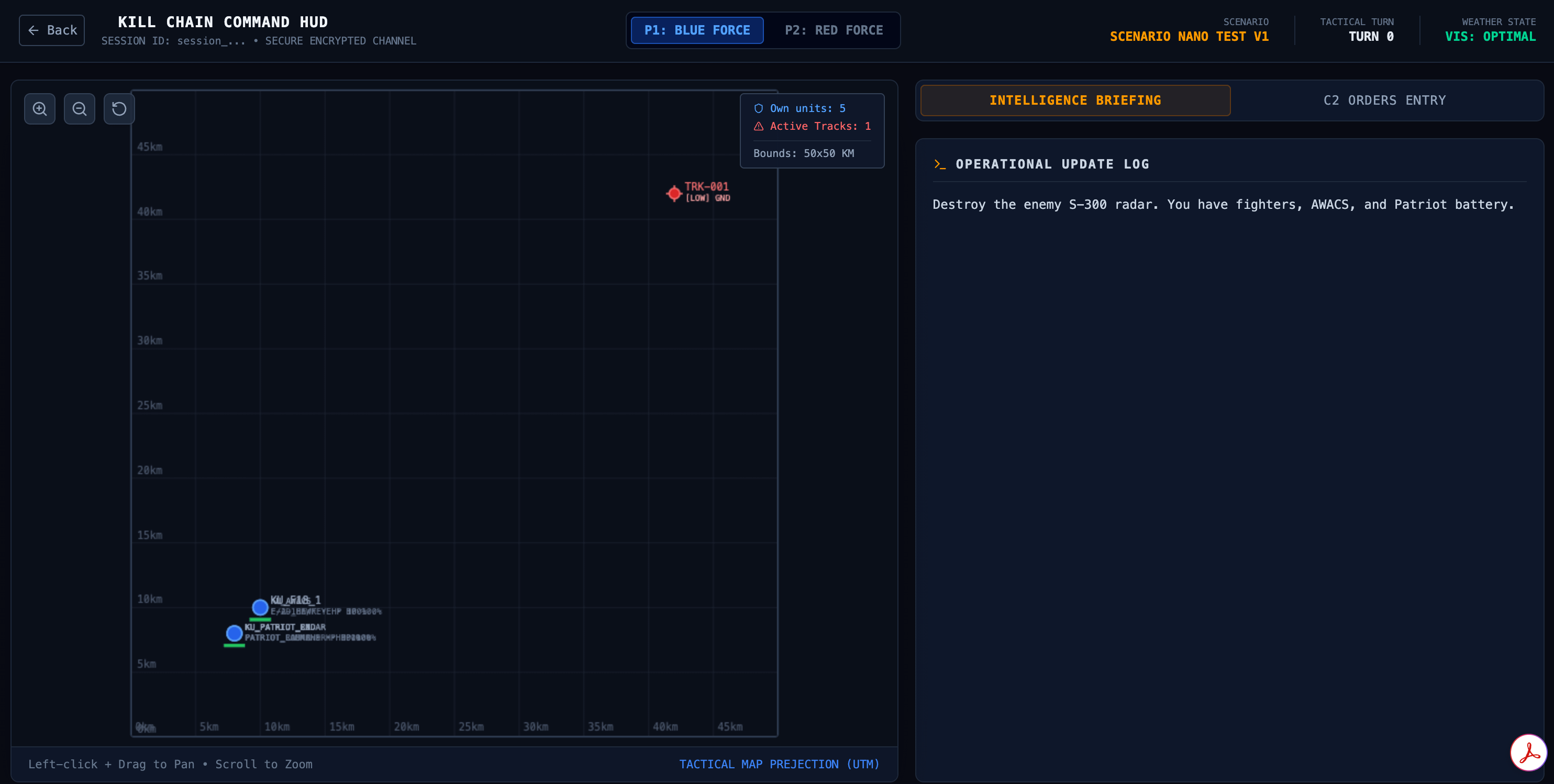
Current learning objective: use the same specification and mockup, and figure out which tool is the most optimal to build a stable and coherentdemo with. The picture shows the tactical HUD of prototype #5 built in Google AI Studio.
The bet underneath it
AI has already rewritten how we write, search, and work. And it’s not finished. Eventually it will come and rewrite our gaming experience as well. Every strategy game since the 90s has asked you to become a master clicker. Every hex game feels like just one more iteration of Panzer General or Heroes of Might and Magic…
What if the interesting version of the genre isn’t faster clicking, but better commanding? That’s the hypothesis Kill Chain is built to test, and I don’t yet know if it’s right. That’s the point of testing it and exploring this avenue.
Applying my own medicine
I wrote a whole book (Venture Speed) about how the best venture studios implement AI and build repeatable systems instead of chasing single brilliant ideas. It felt strange to keep advising founders on that operating system without ever running it on something of my own that had real stakes for me. So I did.
A few of the rules I’ve held myself to on Kill Chain:
Optimize for validated learning, not feature count. The first build had to answer one question: can an AI reliably interpret military intent, before a single extra mechanic got added…
Improve one differentiator ruthlessly. “Command by intent, not by clicks” is the whole promise. Anything that doesn’t strengthen this gets ignored or delayed, no matter how fun it sounded during morning coffee…
AI must be the core, not just an added feature. What would be the point of making just another tactical game if it only iterated on the design and some of the mechanics, but left the core gaming experience (clicks) the same? That’s not too Venture Speed-y. AI needs to take a central position in how the game works and feels…
What exists right now
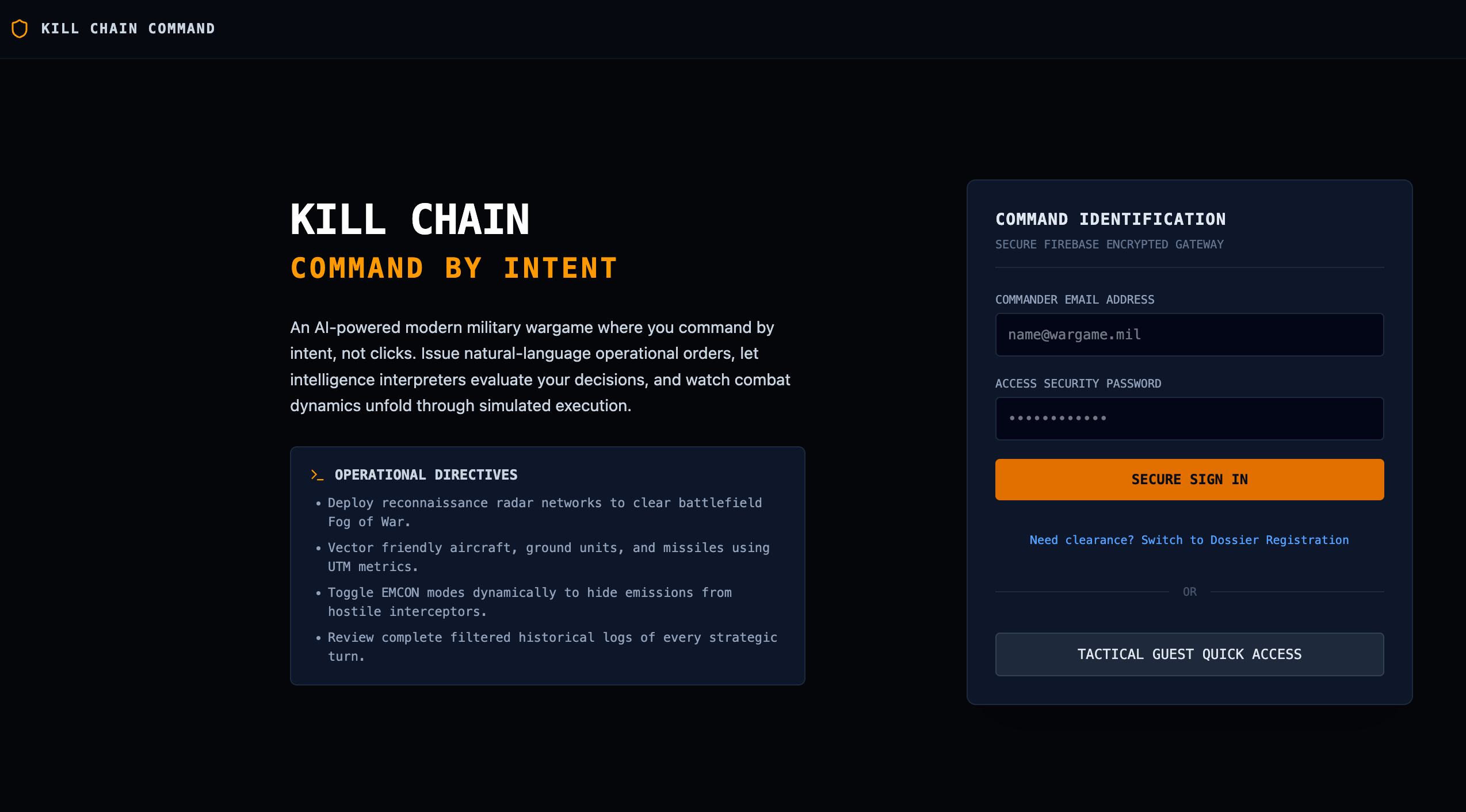
A demo that actually works (tho it breaks a lot) with a working core: login, a mission lobby, a live tactical map rendering real unit positions, narration, and a backend that takes your written orders, runs them through the AI, and updates the battlefield. Rough edges everywhere. Also, genuinely, already fun to figure out the commands I have to give, and watch it unfold.
What’s next
There’s +1 core principle I want to exercise from day one: Build in public, in small batches. Weekly experiments beat quarterly milestones, even for a project with an audience of one.
I’m opening this up to a small group of testers outside my own gaming buddies soon - people who actually care about tactics, military doctrine, or AI-native interfaces. If that’s you, reply or DM me.
And I’ll be honest about the bigger question sitting underneath all of this: I don’t know yet if Kill Chain stays a hobby or becomes something more. I’m deliberately not deciding that yet. That’s also the method: you don’t skip to the business plan before you know if the core interaction is any good.
“Hornet Flight, execute SEAD against…” Command sent. Let’s see what it does.